
RiskScape
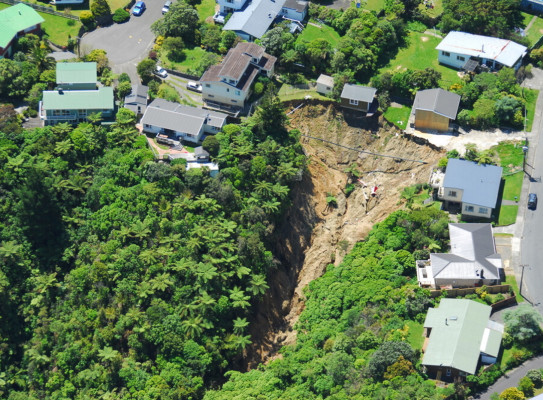
The RiskScape software tool assesses risk to people, buildings, and infrastructure from natural hazards such as volcanic eruptions, earthquakes, landslides, tsunami, and floods. The tool is one of very few open-source risk models available worldwide.
Overview
RiskScape is award-winning technology that has been developed by GNS Science, NIWA and the Natural Hazards Commission Toka Tū Ake with software team, Catalyst – it provides modern software for risk modelling underpinned by the latest scientific research.
Programme aims
- provide natural hazard risk assessment professionals across sectors and disciplines with evidence to understand consequences, make risk-based decisions and implement cost-effective risk reduction solutions
- ensure ease of use for end users, in terms of data input and easy-to-interpret displays of modelling results
To achieve these aims, we are collaborating with multiple organisations to develop RiskScape so that it is multipurpose and serves a range of disciplines. We’re engaging with stakeholders to ensure RiskScape is accessible and easy to use. We also provide a free, open-source version of RiskScape for research purposes that is interoperable with other platforms and tools.
Filling a need for risk modelling
RiskScape allows many sectors, such as land-use planners, asset managers, emergency managers, and insurance providers, to better manage the significant risks posed by future natural hazard events.
RiskScape assesses impacts on people, buildings and infrastructure caused by any natural hazard, including volcanic eruptions, earthquakes, landslides and tsunami. The insights RiskScape provides are key to designing mitigations, disaster management strategies and planning decisions.
The need for an easy-to-use forecasting tool suitable for a range of stakeholders led to the creation of RiskScape, a national research programme examining the impacts of hazards on society, especially in Aotearoa New Zealand.
Having a robust model is largely thanks to years of long-term investment in scientific research through the New Zealand Ministry of Business, Innovation and Employment (MBIE) Hazard and Risk Management Programme (Strategic Science and Investment Fund).
How RiskScape works
RiskScape can model the impacts of natural hazard scenarios to understand the variability and uncertainty of damage expected by a particular event. RiskScape supports open standards and users can use a range of Open Geospatial Consortium (OGC) formats, which gives users the flexibility to provide data specific to their hazard and location of interest.
To calculate risk, RiskScape requires the user to provide:
- geospatial data about the hazard (i.e. GIS layer)
- geospatial data about assets that stand to be damaged (e.g. people, buildings and infrastructure networks)
- consequence functions that estimate loss based on the characteristics of the hazard and assets.
The software uses that information to model potential damage outcomes for different scenarios. Outputs may include the probability of building damage, infrastructure damage, injuries to people, or fatalities.
Depending on the data used and the goals of the user, outputs can also include the probability of damage to crops, the projected cost of different hazard scenarios, and the knock-on effects of cascading hazards, such as initial damage caused by an earthquake and additional damage caused by a subsequent tsunami.
Results can be displayed in a range of intuitive maps, graphs and tables, making it easy for risk modellers to communicate their results to a wide range of stakeholders and decision-makers.
RiskScape
Making us and our environment safer from natural hazards
RiskScape Platform vs. RiskScape Engine
RiskScape is available two ways, via the online Platform and the Engine. With the RiskScape Engine – think standalone, where users construct their own model using their data in a RiskScape pipeline of code. For the RiskScape Platform – think hosted full service, where users get the RiskScape team's expertise to build custom end-to-end risk analysis solutions including models and dashboards to visualise outputs in a cloud-based online environment.
What RiskScape software has been used for
Many GNS projects are already using RiskScape to inform project outputs, including the Cyclone Gabrielle landslide response, the Viet Nam Dam Safety project, Sliding Lands, DEVORA and ECLIPSE.
RiskScape has been used locally and internationally by a variety of stakeholders. Locally, RiskScape is increasingly being used by central and local government agencies and infrastructure operators.
For example, the Natural Hazards Commission Toka Tū Ake and MBIE funded RiskScape to develop a customised risk modelling dashboard to support the response efforts to Cyclone Gabrielle in 2023.
The Natural Hazards Commission Toka Tū Ake are using RiskScape as a replacement for their loss modelling tool due to RiskScape’s ability to model a wide range of natural perils.
A New Zealand emergency management agency is using RiskScape for risk-informed decision making related to natural hazards and other response activities.
The history of RiskScape
The RiskScape research programme has been core-funded by NIWA and GNS since 2004. The first release of the RiskScape software was in 2006 and this platform was operational for 11 years. In 2017, an external review found that a new platform was needed to account for new and advancing technologies.
In 2018, the RiskScape research programme embarked on developing a new, open-source software that could serve end users both domestically and internationally. In 2019, the Natural Hazards Commission Toka Tū Ake provided funding to expedite development and make the model fully probabilistic to account for the inherent uncertainty associated with modelling natural hazards.
-
Report examples

Research programme details
Collaborators: GNS, NIWA
Duration
2004 – present
Funding platform
MBIE Strategic Science Investment Fund (SSIF) (both GNS and NIWA funding) with additional software development funding from Natural Hazards Commission Toka Tū Ake.
Status
Current
Programme leaders
Nick Horspool (GNS)
Ryan Paulik (NIWA)
Funder
Funder: GNS, NIWA, and the Natural Hazards Commission Toka Tū Ake