

Superhot fluidsThe origin and flux of natural greenhouse gases in volcanic areas
Superhot fluids investigates the origin, transport, and interaction of gases, particularly carbon dioxide, within the Taupō Volcanic Zone crust.
Overview
Superhot Fluids is a Royal Society of New Zealand (Marsden Fund) research programme led by GNS Science in New Zealand.
This programme aims to
- better understand the sources and pathways to the surface of naturally emitted gases (such as carbon dioxide, or CO2) from volcanic-hosted geothermal systems, particularly within the Taupō Volcanic Zone crust
- constrain the natural volcanic CO2 of geothermal systems
To achieve these objectives, we will
- use a combination of melt inclusion and mineral noble gas isotope analyses, with surface gas and flux measurements
- create a new model of magmatic degassing and natural greenhouse gas emissions, tracking down volatile gases and magmas from the arc to the surface
The project
Unravelling the science of volcanic gases in hydrothermal systems
What are the sources and pathways to the surface of naturally emitted gases from volcanic-hosted geothermal systems? Subduction zones (where two tectonic plates collide and one plate is thrust beneath the other) are a major conduit for the loss of volatile gases, and New Zealand has one of the most active volcanic arc systems on Earth.
The amount of gas emitted across the central North Island’s volcanic region is poorly constrained. Recent research in Aotearoa New Zealand’s Taupō Volcanic Zone (TVZ) has overturned a 20-year paradigm by showing that shallow (<5 km) magmatic intrusions (rock that has crystallised from molten magma) may not be the basis for surface expressions of gas and heat in New Zealand’s gas-rich geothermal systems.
We have assembled a team of national and international experts (see the list of ‘key people’ below). Together, we will use a combination of melt inclusion and mineral chemistry, noble gas isotope analyses, with surface gas and flux measurements, to trace the origin, transport, and interaction of gases within the Taupō Volcanic Zone crust. The new definitive model of magmatic degassing and natural greenhouse gas emissions will offer greater understanding from source to surface of volatiles transfer in the New Zealand volcanic arc.
Geothermal | Key to the Carbon Neutral Future
Geothermal is a critical source of renewable energy for New Zealand. The question is, can geothermal energy be carbon neutral? To answer this, GNS scientists are developing techniques that prevent CO2 emissions from geothermal power plants.
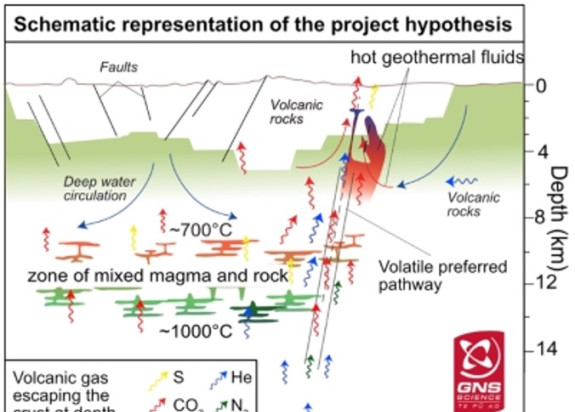
We aim to describe the source, pathway, and flux of gases at the root of the geothermal systems, by addressing the following four questions:
- Do gases from high silica volcanic systems originate from under-plated basalt at depth?
- Have the greenhouse gases that reach the surface from the subduction factory interacted with the crust via magmatism or fluid-rock interaction only?
- What are the implications of volatile release for mass transport modelling and volatile flux in subduction zones? and
- What is the CO2 and H2S flux of the Taupō Volcanic Zone?
Exploring the root zones of magma-driven superhot systems is a prime target for research in geothermally-rich nations. Numerical modelling results suggest that intelligent development of these superheated resources(external link) could increase geothermal power production by a factor of 10. This research programme, therefore, contributes to our understanding of deep geothermal systems while providing a framework upon which to embolden the adoption of renewable energy technologies and understand the fundamental processes driving this applied science scheme.
-
Publications
- Isabelle Chambefort, Michael Rowe, Agnes Mazot, Tsung-Han Jimmy Yang and David Farsky. 2019. Superhot fluids: the origin and flux of natural greenhouse gases in volcanic areas. Proceedings 41st New Zealand Geothermal Workshop 25-27 November 2019 Auckland, New Zealand
- Tsung-Han Jimmy Yang, Isabelle Chambefort, Agnes Mazot, Michael Rowe, Brad Scott, Nick MacDonald, Cynthia Werner, Cornel de Ronde, Tobias Fischer. 2020. CO2 discharge from Lake Rotoiti, New Zealand. Proceedings 42nd New Zealand Geothermal Workshop 24-26 November 2020 Waitangi, New Zealand ISSN 2703-4275
Research project details
Collaborator: University of Auckland
Duration
2019–2022
Funding platform
Marsden Fund
Status
Current
Programme leader
Dr Isabelle Chambefort, GNS Science
Funder
Royal Society Te Apārangi