
Deep Fault Drilling ProgrammeDrilling into a live earthquake fault

DFDP

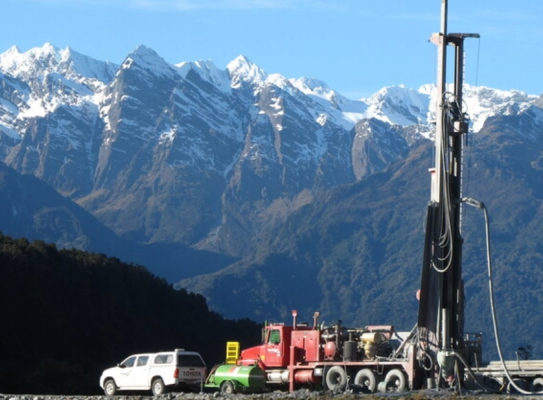
The Deep Fault Drilling Programme drilled nearly 1km into the fault to understand more about its behaviour.

Overview

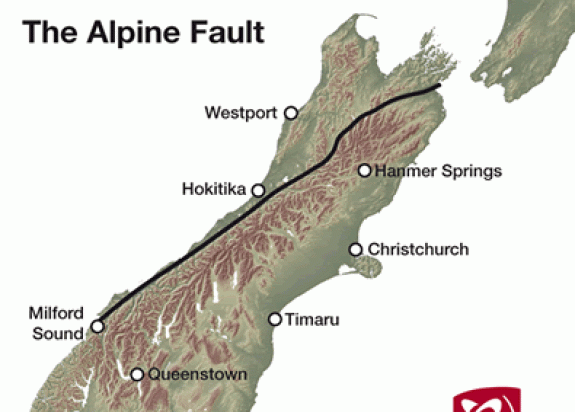
The Alpine Fault runs for about 600km up the spine of the South Island. It’s the land boundary between the Pacific and Australian Plates, and one of the world’s major geological features.

Five things to know about the Alpine Fault.

  1. It has ruptured four times in 1,000 years – 1717, 1620, 1450 and 1100 – producing an earthquake of about M (magnitude) 8 each time.
  2. The likelihood of a major rupture in the next 50 years is much higher than we thought(external link).
  3. The fault is moving horizontally by about 30m per 1,000 years — very fast by global standards. It’s also moving vertically – the alps have been uplifted by an amazing 20km in the last 12 million years. It’s only the fast pace of erosion that has kept their highest point below 4,000 metres.
  4. The rapid uplift has brought deep faulted rock to the surface, enabling scientific study. That same uplift restricts earthquake activity to depths shallower than normal.
  5. Drilling into a live fault overdue for a rupture gives us a rare opportunity to see the state of the fault before it breaks.

Fractured and strongly-layered rocks and extremely hot temperatures put an end to the drilling. While DFDP at Whataroa didn’t achieve all of its technical goals, it made some unexpected discoveries.

The project

A large Alpine Fault rupture could affect us for 50 years

Research from GNS Science and the University of Otago suggests a large Alpine Fault earthquake will trigger a cascade of environmental effects that could last for up to 50 years:

  • violent shaking along the entire length of the rupture will trigger large landslides in steep land and weaken hillslopes making them more susceptible to landslides in subsequent storms
  • as West Coast rivers and streams transport material from these landslides downstream, rivers will change their courses abruptly and more frequently
  • this cascade of impacts may affect towns, road, communications and power infrastructure for decades after the earthquake
  • aftershocks reach M7 and continue for many years

What is the Alpine Fault?

The Alpine Fault in the South Island forms part of the boundary between the Australian and Pacific Plates.

It lies near the base of the steep western range-front of the Southern Alps, stretching over about 600km between Milford Sound and Marlborough. It is visible from space as a more-or-less straight line delineating the western side of the Southern Alps. South-west of Milford Sound, it extends southwest-wards offshore from Fiordland for about 200km. North of Hanmer Springs, it branches into several faults including the Hope Fault and the Wairau Valley Fault.

The Alpine Fault
The Alpine Fault

When the fault slips, land goes sideways and up.

  • the Southern Alps are lifted up
  • rocks are offset laterally by hundreds of kilometres. For example, the Red Hills in Nelson and Red Mountain in South Westland were once joined but have been offset from one another
  • during the last two million years, the central portion of the fault has slipped at an average rate of about 27mm/year horizontally and 10 mm/year vertically

Scientists believe this sort of slip happens mostly during earthquakes of M7.5–8 every 200–400 years. Each time, one side of the fault moves horizontally by approximately 7–9m and 0–3m vertically with respect to the other side of the fault.

Why is the Alpine Fault so interesting?

In the simplest of terms, it’s the way it moves.

When the fault slips, it displaces the rocks on either side horizontally and vertically: rocks on the eastern side of the fault move southwest-wards and upwards. Over time, rocks that were deeply buried beneath the Southern Alps are brought to the surface.

This happens so rapidly – in geological terms – that the rocks don’t have time to cool and many temperature-controlled processes that normally occur at great depth persist to much shallower depths. By studying these processes and the mineralogical and structural signatures they leave behind, we can learn about how the Alpine Fault behaves at the depths at which earthquakes nucleate (approximately 6–12 km). Using rock and fluid samples collected from boreholes enables us to see through the effects of near-surface weathering and erosion.

The Alpine Fault dips downward into the earth at an angle of about 45°. This means we can penetrate the fault more cheaply and more easily than with vertical faults such as the San Andreas Fault(external link).

Drilling into the Alpine Fault

Why would you want to drill into an active plate boundary?

Minerals and the Alpine Fault

Virginia Toy explains how scientists know when they are drilling near to New Zealand's Alpine Fault.

The Deep Fault Drilling Project (DFDP)

Experts believe the Alpine Fault is ready to fail in a large earthquake within coming decades.

Deep Fault Drilling (DFDP) gives us a rare opportunity to determine the state of the fault in the late phase of its seismic cycle – before it breaks. Most other projects have to drilled into active faults after major earthquakes(external link).

DFDP-1: This first phase was completed in February 2011 with two boreholes intersecting the Alpine Fault at Gaunt Creek, South Westland.

DFDP-2 began in October 2014, targeting the Alpine Fault c1km below the Whataroa River Valley.

These two projects were led by GNS Science, Victoria University of Wellington and the University of Otago. Altogether, they involved nearly 100 scientists from more than a dozen countries. They retrieved rock and fluid samples, took geophysical and hydraulic measurements, and set up a long-term monitoring observatory inside the fault zone.

Drilling into New Zealand's Most Dangerous Fault

In 2014 Scientists are drilling more than a kilometre down into the plate boundary fault in New Zealand's South Island.

Is it ok to drill into the Alpine Fault?

Will drilling through a plate boundary fault risk causing a damaging earthquake?

Will the Alpine Fault produce another Darfield?

The Darfield quake on 4 September 2020 was a M7.1 (M = magnitude).

If the Alpine Fault produced a M8.1 quake, it would release about 30 times more energy than Darfield. Here’s the science: for every one unit increase in magnitude – say, from M4 to M5 – there is about a 30-fold increase in energy release.

A rupture in the Alpine Fault will likely:

  • happen over several hundreds of kilometres rather than several tens of kilometres
  • last hundreds of seconds rather than tens of second
  • affect a much larger area than the Darfield earthquake
  • produce an aftershock sequence of earthquakes with at least two M7

Remember: the size of an earthquake is not the only factor determining its severity. We saw this with the 2010–2012 Canterbury earthquake sequence: the M6.3 Christchurch earthquake had a much greater effect than the M7.1 Darfield event five months earlier.

Upton Phaedra 2317

Phaedra Upton Land and Marine Geoscience Theme Leader

View Bio

Phaedra is a geodynamic modeller who researches a wide range of problems in tectonics. She is adept at using numerical models in collaboration with geologists from a range of subdisciplines to produce insights into a large variety of processes including faulting, fluid flow, heat transfer, drainage evolution, placer gold deposition and the relationship between tectonics and genetics. As a Theme Leader at GNS Science, she practises authentic and collaborative leadership. She promotes diversity of thought and inclusivity as vital to achieving our scientific goals. Phaedra was the 2020 New Zealand Geosciences Hochstetter Lecturer.

Contact Me

Find more content related to:

GNS Science topics

By continuing with this download you agree to abide by the rules laid out in the Terms and conditions/Terms of use listed on this page.

If there are no specific Terms and conditions/Terms of use listed then please refer to our Copyright and Disclaimer page and Privacy Policy page

Download