

Seismic imagingImproving Aotearoa New Zealand’s earthquake resilience
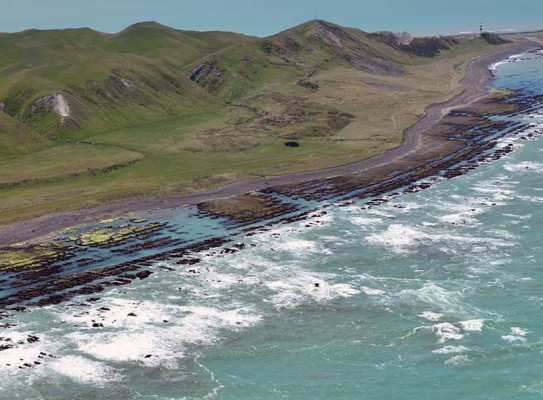
Megathrust faults produce the largest earthquakes with devastating results. What would happen if Aotearoa New Zealand’s Hikurangi megathrust moved? This two-year multi-national programme aims to learn more about megathrust risks.
Overview
The deep structure of the Northeast Japan subduction zone is being compared with that of Southern Hikurangi to investigate how the geology of the overriding plates affect where slips occur on these faults.
GNS Science’s Brook Tozer has been awarded a prestigious Rutherford Foundation postdoctoral fellowship to research Hikurangi. The project will strengthen links with Japanese and US scientists while working on some of the best crustal-scale seismic data ever recorded across two subduction megathrust faults.
The project aims to
- understand the potential extent and slip of a future Hikurangi megathrust earthquake by:
- investigating how closely the Japanese megathrust and Te Moana-o-Raukawa Cook Strait resemble each other to learn how Hikurangi might behave
- improving our ability to assess the hazard posed by the Hikurangi megathrust fault and understanding of megathrusts globally
To achieve these objectives, the project will
- investigate similarities between the Southern Hikurangi and NE Japan megathrust faults by using 3D high-resolution imaging to generate the most detailed pictures to date for these two thrusts
The project
Preparing for the greatest quakes on Earth
Megathrust faults produce the largest earthquakes on Earth. These faults form where two tectonic plates converge and one plate dives down, or subducts, beneath the other. One such megathrust fault – the Hikurangi megathrust – occurs along the east coast of the North Island, where the Pacific plate dives beneath the Australian plate.
Earthquake magnitude is primarily controlled by the area of the fault that ruptures, and how much movement, or slip, occurs during an event. Hikurangi last moved about 500–600 years ago. This means scientists can only make very approximate estimates of future megathrust earthquakes.
Model of Magnitude 8.9 Hikurangi Earthquake and Tsunami
GNS Science researchers produce computer models of a possible plate boundary earthquake and tsunami for civil defence and emergency planning.
Looking globally to learn locally
A natural analogue to Hikurangi is the NE Japan megathrust which produced the 2011 magnitude 9 Tohoku earthquake. This well-recorded event provided invaluable data for understanding the underlying processes that lead to such a large earthquake.
In New Zealand, ongoing research by GNS Science has revealed that the Te Moana-o-Raukawa Cook Strait region bears many similarities to that of Tohoku. This project is investigating how closely the two regions resemble each other, to understand the potential extent and slip of a future Hikurangi megathrust earthquake.
The Hikurangi Subduction Zone Project
The Hikurangi Project is a multinational science investigation of the subduction zone beneath New Zealand's North Island.
High-resolution 3D imaging
Addressing this question requires a detailed comparison of the rock types, their physical properties and 3D distribution to examine and compare their slip behaviour. It uses the geological equivalent of medical CAT scanning. By analysing seismic waves that have travelled through the crust, high-resolution 3D models of the subsurface structure of each region can be generated. This will produce the most detailed pictures to date of the Japanese and Hikurangi megathrust faults, revealing far more about them than was previously possible.
Research project details
Collaborators: GNS Science; Japan Agency for Marine-Earth Science and Technology (JAMSTEC); University of Texas Institute for Geophysics (UTIG), Austin, Texas, USA; Earthquake Research Institute, University of Tokyo, Japan (ERI)
Duration
2020–2022
Funding platform
Rutherford Foundation Postdoctoral Fellowship
Status
Current
Programme leader
Brook Tozer, GNS Science
International collaborators: Shuichi Kodaira, (JAMSTEC), Ayako Nakanishi (JAMSTEC), Dr Adrien Arnulf (UTIG); Associate Professor K Mochizuki (ERI)
Funder
Rutherford Foundation Postdoctoral Fellowship