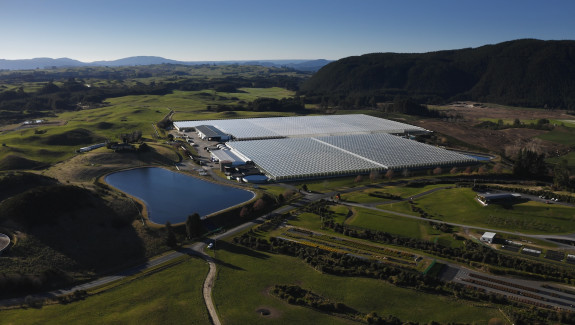
Geothermal Grown Crops Decarbonising covered crops with low temperature geothermal resources
This project will unlock the potential for low temperature geothermal resources to control the indoor temperature of covered crops.
This initiative is supported by the Ministry for Primary Industries’ Sustainable Food and Fibre Futures fund and Vegetables NZ and Tomatoes NZ, and the project delivery has been done in collaboration with Geoexchange NZ.
Geothermal Grown: Decarbonising Covered Crops
This project is designed to support the energy security and decarbonisation efforts of the covered crop industry by unlocking the natural geothermal resource in greater Auckland, Waikato and the Bay of Plenty.
By converting fossil fuel-dependent systems to 24/7 renewable geothermal heating, growers can lower operational costs, reduce emissions, and enhance food and energy resilience.
Our research aims to help the growers make informed decisions by translating complex geothermal subsurface data into a user-friendly web-based tool tailored for the industry.
New web tool for growers...
This project has developed a prototype for an online mapping and information tool that draws together existing data and knowledge about low temperature geothermal resource availability, and combined that data with a calculator to demonstrate how different subsurface conditions can be used for temperature control of covered crop operations.
The tool combines data from a site of interest with glasshouse specifications supplied by the user, first pass estimates of the opportunities for site specific geoheat use that include annual energy use estimations and 25yr lifetime costs are calculated for converting to geoheat technology.
Why geothermal heat?
Learn how tapping into geothermal energy can decarbonise major sectors
Assessments consider ground condition and climate conditions at the chosen location to determine energy requirements for the greenhouse parameters inserted by the user. This information informs different ground-loop designs from which CAPEX and OPEX costs are estimated by the calculator. These values are compared to gas boiler and air source heat pump systems through a levelized cost of heat assessment for a 25-year life span. More details on what parameters influence cost and system performance are provided in the case studies found on the top left links.
-
Disclaimer
This tool is still in development, between April and Nov 2026, we encourage user feedback to improve the usefulness of the tool.
Changes may be made to the datasets and further areas may be made available periodically, without notification.
Where the dataset is used in a figure, presentation, publication or other analysis, Earth Sciences New Zealand requests attribution in the following manner: © Earth Sciences New Zealand 2026.
While all effort is made to provide the most scientifically robust and accurate data, Earth Sciences New Zealand does not warrant or represent that the database is accurate, complete or fit for any particular purpose. Geothermal resources always require site specific testing to access accurate data.
Earth Sciences New Zealand does not accept any responsibility for the use of or reliance on the information provided and shall not be liable to any person on any ground for any loss, damage or expense arising from such use or reliance.
Except where otherwise indicated, Earth Sciences New Zealand retains title to all intellectual property rights in the data or products, including copyright. You will not remove or cover any proprietary notices placed on data or products by Earth Sciences New Zealand.
The interactive map is designed to unlock the natural geothermal resource to support the decarbonisation efforts of the covered crop industry. It presents subsurface temperatures and aquifer flow rates based on local geology, borehole measurements, aquifer characteristics and the national heat flow and groundwater models.
Why This Matters
- Fuel Security Supports Food Security
Covered crop growers are crucial for year-round fruit and vegetable supply in Aotearoa. However, reliance on fossil fuels makes them vulnerable to rising gas prices, ETS costs, and supply disruptions, leading to reduced production and higher costs for consumers. Geothermal energy offers a reliable, cost-effective alternative that strengthens food security while reducing reliance on volatile fossil fuel markets. - Improving Financial Resilience
Energy costs currently account for 30–40% of a grower’s overhead, making geothermal energy an economic game-changer. Unlike other renewable options such as electrification or biomass, geothermal systems operate with lower costs and higher efficiency, aligning with international trends in geothermal adoption for greenhouse horticulture. - Driving Decarbonisation
This project supports New Zealand’s Net Zero by 2050 goal by providing essential fuel switching information to align with Energy Efficiency and Conservation Authority’s (EECA) Covered Cropping Decarbonisation Pathway. By providing accessible geothermal data, the project will empower growers to make informed decisions and transition to low-emissions energy sources. - Supporting National Priorities
The project aligns with government strategies like MPI’s Fit for a Better World and the Aotearoa Horticulture Action Plan, which prioritise transitioning to a low-emissions economy. The success of this initiative contributes to national food resilience. - Alignment with Government Strategy
MBIE’s ‘From the Ground Up’ Geothermal Strategy (2026) states that “Much of our knowledge about New Zealand’s geothermal systems is not consolidated, making it difficult for new market entrants, smaller players and tāngata whenua to assess project viability and invest with confidence.” This project is a first meaningful step to addressing this barrier.