
Measuring emissions from Picton to Bluff: mobile lab heads south on sampling road trip
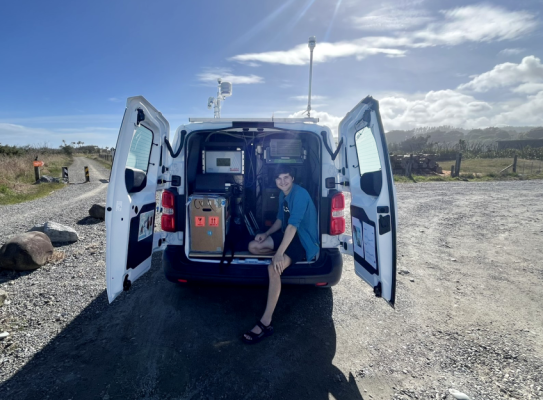
The CarbonWatch-Urban mobile lab has completed its second campaign around the South Island, as part of the Earth Sciences New Zealand research programme’s mission to map the carbon dioxide sources and sinks for every town and city in Aotearoa New Zealand.
Understanding how much carbon dioxide is released by our cities and towns, and how much is absorbed by green spaces, is key for effective development choices and mitigation policies to help Aotearoa meet our net-zero 2050 target.
CarbonWatch-Urban programme lead, Dr Jocelyn Turnbull, says that the mobile lab is a gamechanger in this quest for robust urban emissions information.
“Getting accurate information into the hands of decision-makers is essential for emissions reduction. But only a handful of cities around the world - including Auckland – have the instrumentation to achieve this. Our mobile lab enables us to provide this same information for every town and city in New Zealand.”
The CarbonWatch-Urban team have embarked on a national sampling campaign with the mobile lab, covering a range of urban locations spanning varying climates, geographies and population sizes. The road trips are repeated every three months to account for seasonal variation.
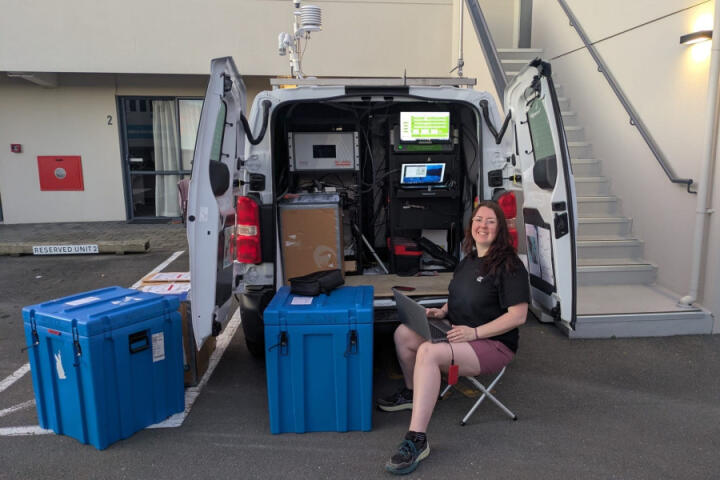
From the outside it may look like a humble electric van, but the mobile lab is anything but. Inside is an array of state-of-the-art instrumentation, modified to be road-trip ready, enabling a range of atmospheric measurements.
While the researchers drive the lab across the country the instruments collect data, mapping carbon dioxide, carbon monoxide, methane and black carbon in real time. The lab visits urban centres for more detailed sampling, and to collect flasks of air for additional analysis that can’t be carried out in the field.
Since first hitting the road in June 2025, the team have carried out sampling road trips around Wellington, the South Island, and around the North Island as far north as Kaitaia. For this recent South Island trip, they were on the road for 11 days, clocking up more than 2,000 km on a route that took them down the east coast from Picton through Christchurch and Dunedin as far south as Bluff, then back north via Queenstown, the West Coast and Nelson.
While this campaign was the lab’s second visit to the South Island, it was the first time in the West Coast. When they travelled south in October 2025, limited electric vehicle charging infrastructure between Wanaka and Hokitika meant they had to plan to take a longer route via Arthur’s Pass, and then severe weather closed the road.
“We were pleased to discover that EV charging has popped up in Haast since our first South Island trip – this was great news for our road trip itinerary, allowing us to travel through Westland, but is also a positive development for traffic emissions mitigation,” says Carbon Cycle Scientist Dr Leigh Fleming who operated the mobile lab with the support of masters student Brayden Lewellen.
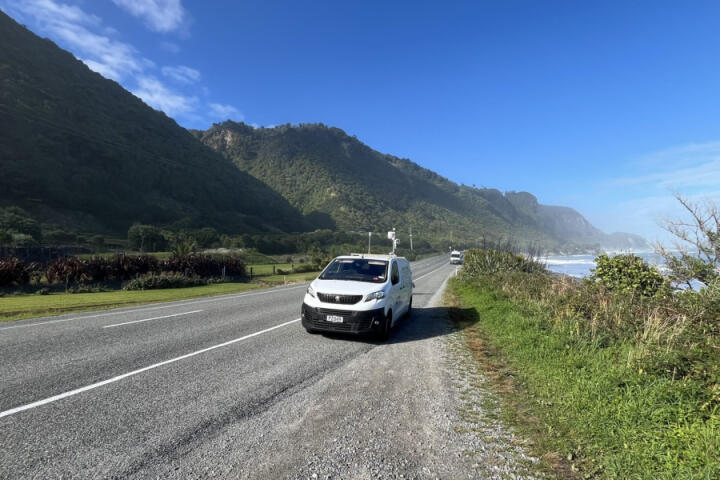
The lab crew can view the greenhouse gas measurements in real time. The instrument is so sensitive that the team can see the peaks in the gases when a car drives past, and they spotted some unexpected spikes in the data in Nelson due to a classic car festival which coincided with the lab’s visit says Dr Fleming.
“These vintage cars don’t have catalytic converters like modern vehicles do, and there were more than 500 of them driving around the town. We saw huge spikes in carbon monoxide and black carbon when they drove near us, something that we don’t see associated with modern cars.”
Dr Fleming and Lewellen collected 30 2-litre flasks of air on the journey. The flask samples will be analysed at Earth Sciences New Zealand’s world-renowned Rafter Radiocarbon Laboratory in Wellington to understand how much of the carbon dioxide is coming from fossil fuels, how much is from biological sources, and to track the amount of carbon dioxide being absorbed by plants.
Atmospheric measurements fine tune ‘bottom-up’ modelling
CarbonWatch-Urban is also extending the existing measurements and instrumentation at four permanent sites in Auckland that continuously measure greenhouse gases.
The researchers combine the atmospheric measurements from the mobile lab and the fixed sites with cutting-edge flux modelling. The modelling draws upon economic data such as fuel imports, vehicle counts, building information, and manufacturing data, as well as satellite measurements of “greenness” to create maps of emissions and sinks over space and time.
The end result will be highly detailed and spatially-resolved information, enabling government, iwi, urban planners, and industry to better monitor their emissions, target mitigation, and develop low-emissions policy.
We’ll be the first country in the world to have high-resolution information for all our urban centres
-
What’s inside the mobile lab?
The kit-out includes a device that can measure carbon dioxide, carbon monoxide and methane in real time.
On one wall is the flask sampler, which allows the team to collect samples of air in 2-litre flasks to take back to the Rafter Radiocarbon Laboratory in Wellington for further analysis.
The black carbon aethalometer allows the scientists to not only document these harmful pollutant emissions, but to use them to diagnose the amount of carbon dioxide coming from traffic and wood burning.
A large empty metal box allows measurement of radon gas, providing an innovative way to accurately quantify the emissions of all the other gases.
Finally, a GPS and weather station sit atop the mobile lab, so that every measurement is fixed to the time and place that it was collected, and the team have a record of where the air arrived from.
-
CarbonWatch-Urban funding and partners
- CarbonWatch-Urban is funded through the Ministry of Business, Innovation and Employment Endeavour Fund. The project is led by Earth Sciences New Zealand (formerly GNS Science), with research partners Manaaki Whenua Landcare Research, University of Auckland, Ministry for the Environment, StatsNZ and Ngāti Whātua Ōrākei.
- For more information about CarbonWatch-Urban visit https://www.gns.cri.nz/research-projects/carbonwatch-urban/(external link)
- Earth Science New Zealand’s Rafter Radiocarbon Laboratory is crucial to this work, providing high precision measurements of radiocarbon in carbon dioxide. It’s the oldest continuously operating radiocarbon facility in the world, with a long history in climate science – it was the first lab in the world to measure radiocarbon in atmospheric carbon dioxide in 1954. It’s the only laboratory in New Zealand that can do these high precision measurements, and there are only a few others worldwide that can do so, so it has a vital role to play in understanding our carbon balance.