

Tipping the balanceWhat makes slow earthquakes episodic
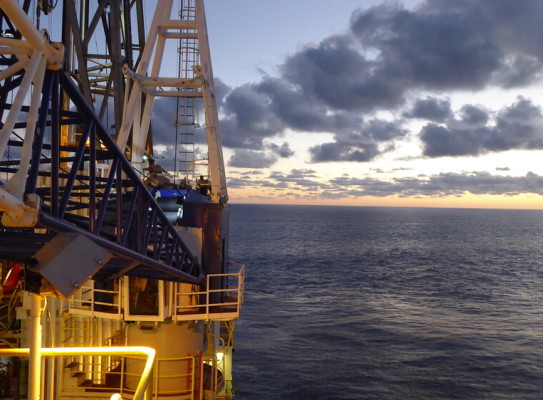
The Hikurangi subduction zone is the focus of GNS Science research on what makes these slow earthquakes episodic.
Overview
Subduction zones, where one tectonic plate descends beneath another, produce Earth’s largest earthquakes and tsunami; but what controls the timing of fault slip in these events?
The recent discovery of frequent, semi-predictable slow-motion earthquakes lasting days to years on subduction faults, provide an untapped opportunity to investigate what tips the balance on these faults, causing them to fail.
The Hikurangi subduction zone lies off the North Island’s East Coast, where the Pacific tectonic plate dives under the Australian plate off the North Island’s East Coast. It is the best place in the world to study slow earthquakes.
Here, slow-motion earthquakes are remarkable for the range of slow and fast seismic slip processes occurring at shallow depths of less than 10km. It offers a globally unique opportunity to resolve processes driving slip on subduction zones using near-field monitoring.
The project was awarded funding by the Marsden Fund in 2020, recognising excellent science with maximum impact for Aotearoa New Zealand.
The project aims to
- detect localised subduction fault changes prior to slow earthquakes, revealing the physical mechanisms that regulate slip timing on a major fault capable of generating devastating earthquakes and tsunami
- determine whether seismologically observed changes in fault properties preceded slip, ultimately enabling future development of more accurate forecasts of both slow and possibly fast (seismic) slip earthquakes
To achieve these objectives we are
- using onshore and offshore sensors coupled with novel geophysical methods to detect high-resolution changes in fault properties leading into an upcoming slow-slip event offshore southern Hawkes Bay, and a recent Gisborne event
The project
Seeking the cause of slow-slip earthquakes
Unravelling the causes of slow-slip earthquakes under the seafloor east of the North Island may lead to more accurate forecasts of big quakes and tsunamis generated by the Hikurangi subduction zone.
The project is applying next-generation techniques to seismic imaging data previously gathered off the southern Hawke’s Bay coast in 2005. The result is a whole new view of parts of the Hikurangi subduction zone. Geoscientists can now better visualise the interface between the Pacific and Australian tectonic plates to find out what’s going on underground.
Subduction zones are the biggest earthquake and tsunami factories on the planet, but we need to first solve the mystery of slow-slip events. These events can release the equivalent of a magnitude 7 earthquake, but over weeks or months. Their discovery 20 years ago has revolutionised seismology and the understanding of fault mechanics.
A supercomputer at the Texas Advanced Computing Center identified patterns in the data enabling scientists to narrow their focus to the physical conditions in the fault where slow-slip events occur.
These slow-slip events are an important part of earthquake cycles because they occur in the same places as large magnitude earthquakes.
What is a Slow Slip Event?
Explanation of slow slip earthquakes associated with New Zealand's Hikurangi Subduction Zone.
Detecting Slow Slip Earthquakes
The Hikurangi Project is a multinational science investigation of the subduction zone beneath New Zealand's North Island.
Increasing the monitoring sites
Tantalising evidence in recent years suggests a build-up of fluid pressure near the fault exerts a major control on timing of slow-slip quakes in New Zealand. Monitoring pressure accumulation in the fault may enable better forecasting of slow, and possibly, fast earthquakes in the future.
Is fluid change in the fault a symptom or the cause, or is it the steady build-up of stress from tectonic plate motion? To help find the answer, scientists have mounted a large-scale deployment of undersea and land-based monitoring instruments in southern Hawke’s Bay and Wairarapa. They will monitor changes before, during and after a regularly recurring slow-slip event expected offshore sometime before 2023.
The project is forging new ground in seafloor geodesy and will help put New Zealand at the forefront of global efforts to monitor offshore faults that can generate large quakes and tsunamis.
Research project details
Collaborators: Dr Katrina Jacobs: GNS Science; Dr Emily Warren-Smith: GNS Science; Associate Professor Pascal Audet: Department of Earth and Environmental Sciences, University of Ottawa, Canada; Associate Professor Kimi Mochizuki: Earthquake Research Institute, University of Tokyo, Japan (ERI); Professor Demian Saffer: University of Texas Institute for Geophysics (UTIG), Austin, Texas, USA; Professor Martha Savage: School of Geography, Environment and Earth Sciences, Victoria University of Wellington, New Zealand; Professor Spahr Webb: Lamont-Doherty Earth Observatory, Columbia University, USA
Duration
Funding platform
Marsden Fund
Status
Programme leader
Dr Laura Wallace, GNS Science