
NZ evidence suggests cooling helped kill the dinosaurs
New evidence from New Zealand suggests that colder weather forced dinosaurs into decline well before the Earth was hit by a meteorite that finished them off.
Three years of research, published in a special issue of the New Zealand Journal of Geology and Geophysics, suggests that many species living at the time of impact were unable to adapt to a gradual global cooling that occurred before the impact.
The research has cast doubt on the belief that up to 75 percent of all species became extinct 65 million years ago when a meteorite hit the Yucatan Peninsula in Mexico. The impact of the meteorite may have been overestimated in some studies.
The New Zealand research indicates there were fewer extinctions in New Zealand, because at the time it was 1500km closer to Antarctica and most surviving species were already adapted to the cold and long periods of darkness.
Palaeontologist and project leader Chris Hollis, of GNS (Geological and Nuclear Sciences Ltd), said the three-year research project had confirmed that the asteroid impact effects were worldwide and essentially instantaneous.
However, the reappearance of several survivor species after the impact shows that, even though the effects were global, the survival rate of species in New Zealand was higher than in the Northern Hemisphere.
An unknown number of species may have been in sharp decline when the asteroid struck and the impact winter probably finished them off quite quickly,
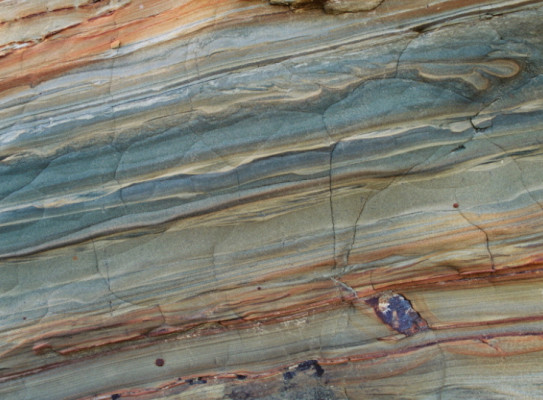
By studying fossils and sediments at six New Zealand sites, the research team found a centimetre thick layer of meteorite dust occurred precisely at the time of major environmental change 65 million years ago.
This included abrupt displacement of diverse forest communities by ferns - known for their ability to colonise bare ground. They also found equally abrupt changes in microscopic plants and animal fossils in marine sediments.
The New Zealand research has also turned up evidence for significant climatic change prior to and following the asteroid impact.
"It now appears that impact may not have been the sole cause of the massive species turnover at the end of the Messozoic era [65 million years ago]," Dr Hollis said.
The importance of gradual species turnover related to long-term climatic cooling had been obscured by an episode of unusually warm conditions just prior to impact.
The warming may have allowed a final flourishing of some species that were already on the path to extinction.
The cool climate that prevailed in New Zealand for millions of years after impact might not be, as some had supposed, evidence for a prolonged impact winter.
"Instead, it may represent a return to normality following unusual warming at the end of the Mesozoic (65 million years ago).
"There's no scientific agreement on what caused this climatic instability, but it's quite likely that current studies are over-estimating the effect of the asteroid impact."
Dr Hollis said the dominant drivers of climate change before the time of impact were poorly understood.
Some scientists believe that huge episodes of volcanism caused successive warming and cooling of the earth's climate in the few million years prior to impact.The asteroid impact is the last of five great mass extinctions on Earth. The causes and nature of extinctions at the end of the Mesozoic era are still poorly understood. But they are worth studying for several reasons:
- Collision with an asteroid will happen again
- It provides an analogue for the effects of nuclear war and greenhouse warming
- It gives an insight into biodiversity collapse.
The 320-page special issue of the NZ Journal of Geology and Geophysics is available from the Royal Society of New Zealand. Material in the publication has been peer reviewed by an international panel of reviewers.