
New company RockXtract tackles cement’s carbon problem at its source
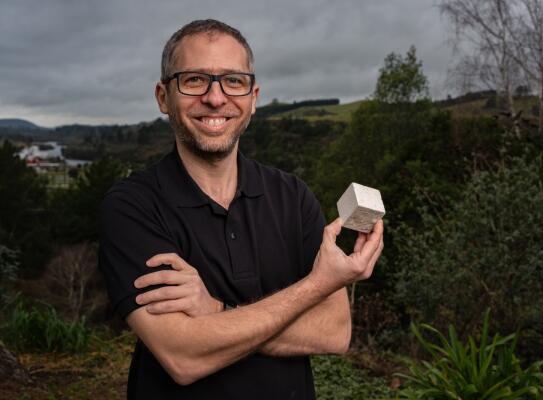
Cement is the second most widely used substance in the world after water, with global demand reaching billions of tonnes each year. Its production also generates an estimated 2.3 to 2.8 billion tonnes of CO₂ each year, which is around 8–9 percent of total global emissions.
The emissions from conventional cement (Portland cement) production are driven by both fossil‑fuel use and a chemical process that releases CO₂ when limestone is heated above 1,000°C. As global demand for cement continues to grow, reducing these emissions at scale has become one of the most urgent challenges in the energy transition.
Introducing RockXtract, now officially a new company and the first to spin out from the recently-formed Earth Sciences New Zealand. The RockXtract team are addressing cement’s emissions at its source by replacing traditional calcination with a novel chemical process, commercialising technology developed at Missouri University of Science and Technology alongside Earth Sciences New Zealand.
“By eliminating the need for extreme heat, our process dramatically reduces both energy use and process emissions, addressing the core drivers of cement’s carbon footprint."
The result is a cement alternative that performs like conventional products, while achieving an estimated 70–95 percent reduction in emissions
Just as importantly, the approach is designed for scale. The raw materials RockXtract uses are widely available and underutilised, such as slags and fly-ash, and mafic and ultramafic rocks.
“The idea is to also enable local cement production near quarry sites, which will help reduce transport emissions, lower energy demand, and ensure our technology integrates with the existing supply chains” says Rendel.
Early indications also point to the potential for cost competitiveness at commercial scale. That practicality, and the geochemical innovation, has attracted the attention of the global cement and concrete industry.
RockXtract has now successfully formed a strategic consortium with leading construction materials companies including CRH, Heidelberg Materials, Çimsa, GCC, and JSW Cement. Their collaboration brings access to technical expertise, industrial infrastructure, and the commercial pathways needed to accelerate validation and market readiness. These connections and testing of ideas is being made possible through the support of the Global Cement and Concrete association and their innovation accelerator, the Innovandi Open Challenge 2025.
So far, engagement with cement manufacturers has been positive, particularly given the technology’s alignment with industry decarbonisation commitments and indications of its ability to perform as well as conventional cement.
RockXtract’s journey from laboratory research to global industry collaboration highlights the role that New Zealand‑linked science can play in delivering commercially viable climate solutions. From lab to global stage, the company represents a significant step toward low‑carbon concrete at the scale the world now demands.
For all media enquiries, please call the Earth Sciences NZ media phone on +64 21 574 541 or email us here(external link) .
Dr Peter Rendel is available for interviews.