
Tritium and Water Dating Laboratory
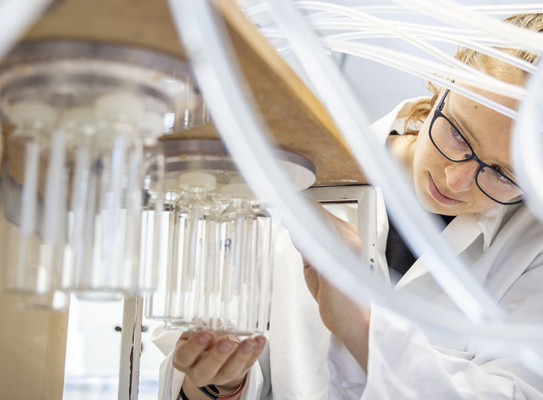
GNS prides itself on being home to the world’s most accurate tritium dating facility. Our reputation for innovation, precision and analytical capabilities has resulted in our work influencing national and international research and environmental programmes and policies.
The work we do enables governments, councils and resource managers, and industry to better understand, manage and protect precious water resources, and to provide secure drinking water to New Zealand communities.
Environmental tracer data from our lab provides evidence of how catchments sustain flow in their river discharges, how rivers sustain the coastal aquifers (the water source for most of our population), and how groundwater interacts with geothermal systems.
Our Expertise
The Tritium and Water Dating Lab at GNS has a proud 62-year history of delivering high-sensitivity tritium analysis and water dating services. We are internationally renowned for our ability to achieve the highest levels of accuracy and precision in tritium analysis (with a detection limit of 0.02 TU and reproducibility of 1%).
Our results create new understanding of hydrological processes, including:
- Land use impact on groundwater quality and nitrate loads from legacy land use sources
- Source and rate of groundwater recharge
- Water dynamics through river catchments
- Recharge of river water into the coastal aquifers
- Validation of groundwater flow models
- Rate of hydrogeochemical processes
- Ice core dating
- Ocean circulation.
Complementing our analytical capabilities, the Tritium and Water Dating Laboratory also operates a modern sample processing laboratory for purifying water and sediment material for analysis – including a state-of-the-art electrolytic enrichment system to improve tritium measurement sensitivity. Our tritium and water dating experts undertake collaborative research and we collaborate in research focused on New Zealand and around the world.

Our Equipment:
- Quantulus low-level liquid scintillation spectrometers - for measuring Tritium (³H), ²²²Rn and other isotopes used as tracers and/or calculating ages in sediments and water.
- Picarro L2130-i analyser – for measuring the δ¹⁸O and δD composition of water samples.
- Shimadzu GC-2030 gas chromatograph – for measuring the concentration of Chlorofluorocarbons (CFCs) including CFC-11, CFC-12, and CFC-113 in gas and water samples. Measurement of Ar and N₂ are also measured on this system, which enables estimation of recharge temperature and excess air at the time of groundwater recharge.
- Shimadzu GC2014 gas chromatograph - for measuring Sulfur hexafluoride (SF₆) and Halon-1301 concentrations in gas and water samples.
- PlasmaDetek II plasma emission detector - attached to the Shimadzu GC2014 gas chromatograph; used for measuring of Ne, Ar, and N₂ concentrations in gas and water samples to calculate excess N₂ produced by denitrification.
- Hiden HAL 3F-PIC Quadrupole Mass Spectrometer - for high-precision measurement of noble gas (He, Ne, Ar, Xe, and Kr) concentrations in gas and water samples. This system is designed primarily to quantifying denitrification in groundwater systems, and can be used for many other applications that require knowledge of noble gas concentrations (e.g., geothermal fluids, pore-water analysis, etc).
- Helix MC multicollector Noble Gas Mass Spectrometer – for measuring high-precision isotope ratios of noble gas (He, Ne, Ar, Xe, and Kr).
Accreditation
The GNS Science water dating lab is currently recognised by the International Atomic Energy Agency (IAEA) as the most precise tritium laboratory in the world.
Our Clients
Our services are sought out by government agencies involved in water resource management, drinking water providers, universities, industrial and commercial clients, and other groundwater research providers.
We provide analytical services for international researchers and our work has industrial applications in groundwater resource, climate change, oceanography, geothermal dynamics and hydro-dam security. We also participate in a range of IAEA international inter-comparison tests.
Our Location
The Tritium and Water Dating laboratory is located at the GNS Science campus in Avalon, Wellington.
-
Analysis Available
The Water Dating Lab carries out analysis of Tritium, CFCs, SF6, Halon 1301, Radon and Excess-N2. We can also help facilitate analysis at our other GNS labs for stable isotopes and radiocarbon if required.
-
Sample Bottles
Read about the specifications needed for Sample Bottles here (PDF, 2.1 MB)
-
Submission Documentation
Please contact us for your Sample Submission Form and Import Permit
Sample Submission Form
All samples should be accompanied by a printed copy of our Sample Submission Form with sufficient documentation to identify each individual sample. A copy of the Submission Form should also be emailed to waterdating@earthsciences.nz prior to shipping.MPI Import Permit
Samples sent from outside New Zealand MUST be accompanied by a copy of our Import Permit. Failure to do this may result in your samples being delayed on entry into New Zealand. Do not send your samples without the permit.Please print and attach the Import Permit with the shipping paperwork on the outside of the package. You can also write the permit number on the package, so it is easily seen.
-
How to Send Samples
Use courier or registered post. Trackable courier dispatch or registered post is recommended, and samples are acknowledged on receipt by us. If courier firm insists on a value for the contents, use $1.00. Label package as: "Samples for Scientific Analysis - no commercial value".
Send samples to:
Earth Sciences NZ (formerly known as GNS Science)
Water Dating Lab
Attn. Vanessa Trompetter
1 Fairway Drive, Avalon
Lower Hutt 5011
New ZealandContact phone number for courier packages: +64 4 570 1444
Please email waterdating@earthsciences.nz and notify us of any incoming samples. -
Price List
Download our pricelist here. (PDF, 140 KB)
Please Contact us using the form below to discuss your needs before sending your samples to our lab. Download our terms and conditions here (PDF, 197 KB).