
Central volcanic region and Taranaki objective

Ruapehu

Objective Leader: Dr. Pilar Villamor

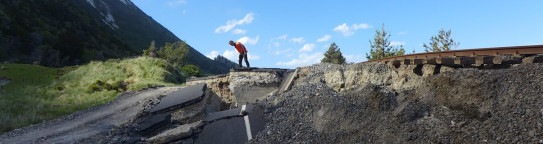
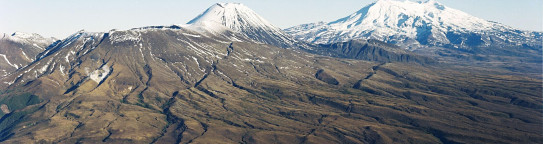
As a consequence of the subduction of the Pacific plate below the Australian plate in the North Island of New Zealand, volcanoes are formed in the central and western regions of the island, from White Island to Ruapehu, and west to Taranaki. In these regions, the dominant type of earth deformation caused by the plate movement is "extension", that is, blocks of crust are pulled apart from each other. The physical planes between these blocks are known as normal faults. Extension in this region is achieved by differential movement of crust blocks along normal faults and by injection of volcanic magma into the upper crust. This objective aims to quantify deformation patterns in the region of active extension and volcanism of the North Island. The range of our studies extends from general analysis of tectonic models of extension (rifting) processes to detailed estimates of individual fault ruptures. For this purpose, we are undertaking multidisciplinary research that comprises deep geophysical techniques (electro magnetics, seismology), shallow geophysics (seismic, gravity, GPR), active faulting and structural geology studies, and remote techniques such as GPS and synthetic aperture radar. Results of these studies are used to improve seismic and volcanic hazard assessment, and provide input to geothermal energy research in New Zealand.

We currently have four tasks within the objective:

1 Seismic reflection surveying of active faults (leader Dr. Andy Nicol): Shallow geophysics studies (shallow seismics, GPR) aim to help us understand the tectonic deformation and structure of the upper part of the crust.

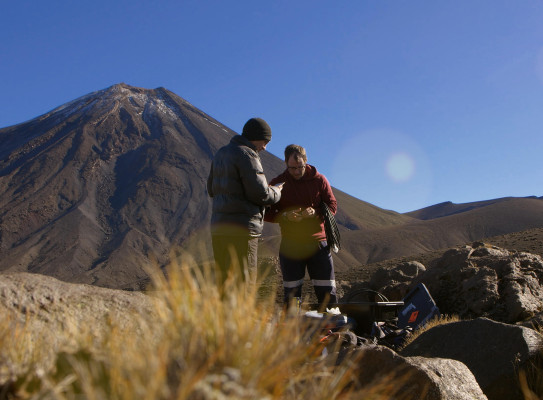
2 Electromagnetic surveying of crustal structure (leader Dr. Hugh Bibby): The deep structure of this part of the North Island is studied by means of deeper geophysical techniques such as magneto-telurics.

3 GPS surveying of crustal deformation (leader Dr. Laura Wallace): We use GPS techniques to measure the active deformation patterns in the North Island. We are currently using GPS measurements to estimate the rate of extension in the TVZ region, as well as quantifying the seismic hazard posed by stress build-up on the subduction zone beneath the North Island.

4 Geological studies and synthesis (leader Dr. Pilar Villamor): Active faulting and structural geology studies, in conjunction with geophysical studies mentioned above, are currently focusing in the spatial and temporal evolution of the Taupo Rift. Paleoseismology studies contribute to understand fault rupture processes, earthquake clustering, fault growth and associations between earthquakes and volcanic eruptions.

Selected publications

  • Berryman, K., Villamor, P., Nairn, I., Van Dissen, R., Begg, J., Lee, J. 2008. Late Pleistocene surface rupture history of the Paeroa Fault, Taupo Rift, New Zealand. New Zealand Journal of Geology & Geophysics, 2008, Vol. 51: 135–158
  • Hayes, G., Reyners, M., Stuart G. 2004. The Waiouru, New Zealand, earthquake swarm: Persistent mid crustal activity near an active volcano. Geophysical Research Letters, vol. 31, L19613, doi:10.1029/2004GL020709
  • Nairn, I. A., Hedenquist, J.W., Villamor P.; Berryman K.R., Shane P. R. 2004. Were contemporaneous rhyolite and hydrothermal eruptions driven by an arrested basalt dike system? The ~AD1300 Tarawera and Waiotapu eruptions, New Zealand. Bulletin of Volcanology 66(6) DOI: 10.1007/s00445-004-0373-7.
  • Nicol, A., Wallace, L.M. 2007. Temporal stability of deformation rates: comparison of geological and geodetic observations, Hikurangi Subduction Margin, New Zealand. Earth and Planetary Science Letters, 258: 397–413.
  • Nicol, A., Walsh, J., Berryman, K., Villamor, P. 2006. Interdependence of fault displacement rates and paleoearthquakes in an active rift. Geology, 34 (10): 865-868.
  • McClymont, A.F., Green, A.G., Villamor, P., Horstmeyer, H., Grass, C, Nobes, D.C. 2007 accepted. Characterizing the shallow structure of active fault zones using GPR. Journal of Geophysical Research - Solid Earth.
  • Mouslopoulou, V., Nicol, A., Little, T.A. & Walsh, J.J., 2007. Terminations of large strike-slip faults: an alternative model from New Zealand. In: Tectonics of Strike-Slip Restraining and Releasing Bends in Continental and Oceanic Settings. Geological Society of London, Special Publication 290, 387-415.
  • Mouslopoulou, V., Nicol, A., Walsh, J.J., D. Beetham, D. & Stagpoole, V., 2008. Quaternary temporal stability of a regional strike-slip fault and rift intersection. Journal of Structural Geology 30, 451-463.
  • Reyners, M., Eberhart-Phillips, D. & Stuart, G. 2007. The role of fluids in lower-crustal earthquakes near continental rifts. Nature, 446 (26) doi:10.1038/nature05743.
  • Tronicke, J.; Villamor, P; Green A. 2006. Detailed shallow geometry and displacement estimates of the Maleme Fault Zone, New Zealand, using 2-D and 3-D georadar. Near surface geophysics, 4, 155-162.
  • Villamor, P., Berryman, K.R. 2001. A Late Quaternary extension rate in the Taupo Volcanic Zone, New Zealand, derived from fault slip data. New Zealand Journal of Geology and Geophysics, 44(2): 243-269.
  • Villamor, P., and Berryman, K. 2006. Late Quaternary geometry and kinematics of faults at the southern termination of the Taupo Volcanic Zone, New Zealand. New Zealand Journal of Geology and Geophysics, v. 49, p. 1-21.
  • Villamor, P., Berryman, K.R. 2006. Evolution of the southern termination of the Taupo Volcanic Zone, New Zealand: New Zealand Journal of Geology and Geophysics, v. 49, p. 23-37.
  • Villamor, P., Van Dissen, R., Alloway, B., Palmer, A., Litchfield, N. 2007. The Rangipo Fault, Taupo Rift, New Zealand: an example of temporal slip rate and single event displacement variability in a volcanic environment. Bulletin of the Geological Society of America, 119: 529-54.
  • Wallace, L.M., Beavan, R.J., McCaffrey, R., Darby, D.J. 2004. Subduction zone coupling and tectonic block rotations in the North Island, New Zealand. Journal of geophysical research. Solid earth, 109(B12): B12406, doi:10.1029/2004JB003241.
  • Wallace, L.M., McCaffrey, R., Beavan, R.J., Ellis, S.M. 2005. Rapid microplate rotations and backarc rifting at the transition between collision and subduction. Geology, 33(11): 857-860.

Downloads

Publications.pdf 132.60 kB

Links
GNS research

Follow the links above to individual research project pages.