
Home / Our Science / Natural Hazards / Earth's Forces / Landslides / New Zealand Landslides

New Zealand Landslides

green lake landslide 1

Aerial view of the Green Lake Landslide looking southeast across bush-covered, hummocky slide debris (SD), comprising many semi-intact blocks, to the V-shaped scarp (HS) and Green Lake (GL), a large landslide pond at the foot of the head scarp. The flat area in the foreground is the former landslide-dammed lake that has been infilled with glacial sediments and swamp deposits, and now forms the headwaters of the Grebe River that flows north (left) into Lake Manapouri. Part of a former overflow channel (OC) from the former lake can be seen at the right of the photo.

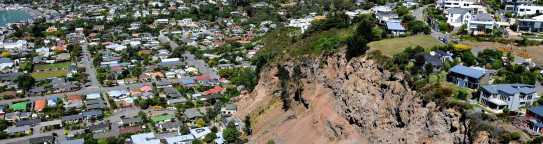
Among the most dangerous processes are deep-seated landslides, such as the 1991 collapse of the summit area of Mount Cook, and the 1979 Abbotsford landslide that destroyed 63 houses in southern Dunedin, fortunately without loss of life.

The Falling Mountain rock avalanche, triggered by the 1929 Arthur's Pass earthquake, resulted in 55 million cubic metres of rock spread 4.5 km down the valley.

Probably the most significant catastrophic landslide in New Zealand is the Green Lake landslide near Lake Manapouri. This 26 cubic-kilometre slide occurred about 13,000 years ago due to the collapse of 10 km of the Southern Hunter Mountains. It may be the world's largest rock slide. More info…